


9 Financial Mistakes Small Business Owners Make (and How to Avoid Them)
- Donna Roggio

- May 24
- 9 min read
Financial mistakes small business owners make rarely happen because of carelessness. They happen because nobody taught you this stuff. You learned how to deliver your service, build your product, and find your customers. But the financial side? Most business owners are figuring that out in real time, and the learning curve has a price tag attached to it.
According to a U.S. Bank study, 82% of business failures are tied to cash flow problems. A QuickBooks financial literacy survey found that 42% of small business owners started their businesses with limited or no financial literacy. And SCORE research shows that 60% of small business owners feel they don't have enough knowledge about accounting and finance.
None of those numbers are meant to make you feel bad. They're meant to show you that if you've made financial mistakes in your business, you're in the majority. The difference between staying stuck and moving forward is awareness. Once you can see the mistake, you can fix it.

Here are nine of the most common financial mistakes small business owners make, with a specific, actionable fix for each one.
Mistake 1: Mixing Business and Personal Finances
This is the most common starting point for financial chaos. QuickBooks data shows that 70% of small business owners have used a personal credit card for business expenses. The IRS specifically warns that not separating business and personal expenses is one of the four most common tax errors for small businesses, because it leads to mistakes when claiming deductions and creates serious problems during an audit.
When everything runs through one account, you can't see your true business profit. You can't see your real personal spending. And your tax preparation becomes a months-long untangling project instead of a straightforward process.
The fix: Open a dedicated business checking account if you don't have one. From this point forward, run all business income and expenses through that account. For transactions that are genuinely mixed, use a system that supports split transactions so you can allocate the correct amounts to each side. We covered this in detail in our post on how to separate business and personal finances.
Mistake 2: Not Tracking Where Your Money Goes
You can't manage what you can't see. Yet a surprising number of business owners operate without any real tracking system. They check their bank balance, make a mental estimate of what's coming in and going out, and hope for the best. That's not a financial strategy. That's a guessing game.
According to Forbes, not monitoring finances regularly is one of the biggest financial mistakes business owners make. The article emphasizes that regular financial monitoring helps identify issues early, like cash flow challenges, declining profitability, or unexpected expenses, so you can address them before they spiral.
The fix: Set up a tracking system that you'll actually use. This doesn't need to be complex. It needs to be consistent. Whether you use a spreadsheet, an app, or a comprehensive system like Money Mastery that brings personal and business finances together with AI-powered categorization, the important thing is that every dollar has a place and you can see the full picture. Start with our guide on how to track where your money goes if you're starting from scratch.
Mistake 3: Ignoring Cash Flow Timing
Revenue and cash flow are not the same thing. You can have $50,000 in outstanding invoices and still not be able to cover rent this week. Cash flow is about timing: when money actually arrives in your account versus when expenses are due.
The U.S. Chamber of Commerce Small Business Index and Kaplan Group research found that 51% of small businesses struggle with uneven cash flows. That's more than half of all small businesses operating in a constant state of cash flow uncertainty.
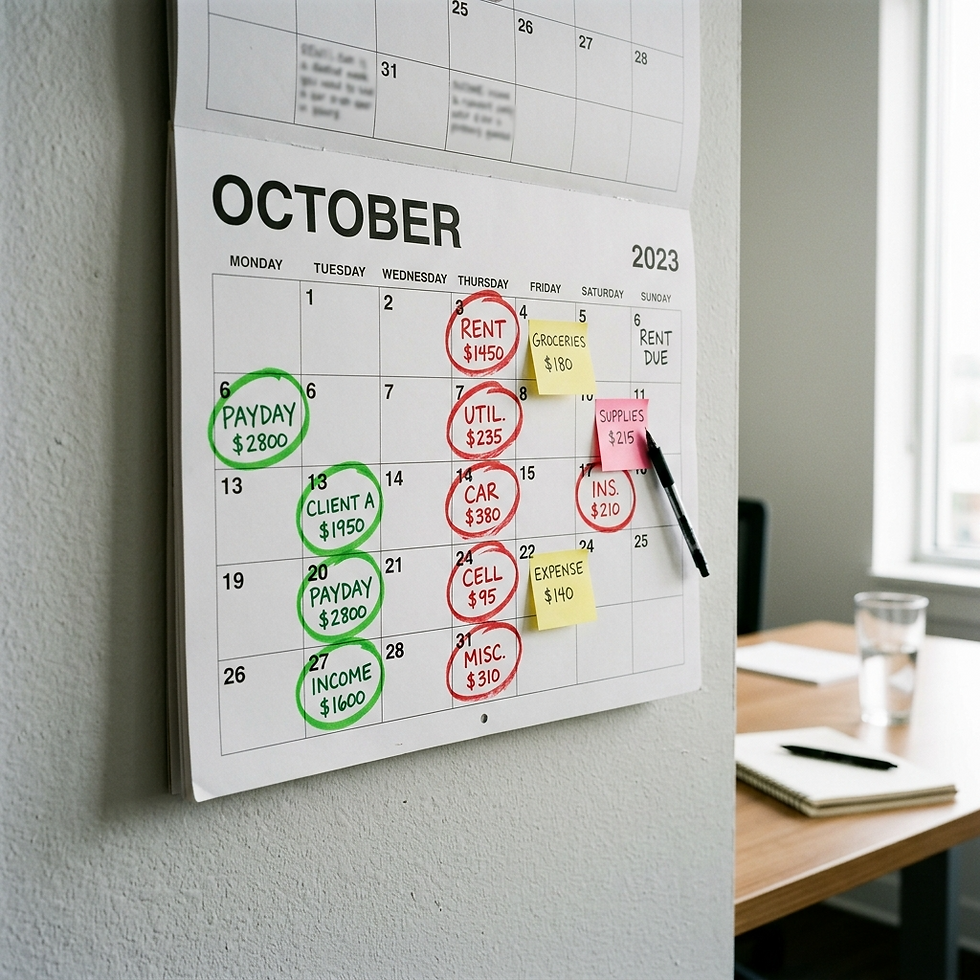
The fix: Start tracking when money comes in, not just how much. Look at your last three months and note the gaps between when you invoice and when you get paid. Then look at when your bills hit. If there's a pattern where expenses come due before income arrives, you need to either adjust your payment terms, build a cash buffer, or shift your billing schedule. Even a simple calendar view of money in versus money out by week can reveal timing problems you've been feeling but couldn't see.
Download the free 15-Minute Financial Clarity Starter Kit at https://moneymastery-system.com/starter-kit. It includes a spending leak audit and a personal P&L snapshot template that help you spot several of these mistakes in one sitting.
Mistake 4: No Tax Savings Strategy
The IRS doesn't wait for you to be ready. Underpaying estimated taxes is the first mistake on their official list of common small business tax errors. The penalty for underpayment is calculated on the amount you should have paid, and it adds up faster than most people expect. The IRS accuracy-related penalty alone is 20% of the underpayment amount.
A QuickBooks study found that less than half (48%) of small business owners are confident they're paying taxes correctly. That means more than half are unsure whether they're even meeting their basic tax obligations.
The fix: Set aside a percentage of every payment you receive for taxes. A common starting point is 25-30% of net income, though your actual obligation depends on your tax bracket and deductions. Open a separate savings account specifically for tax money. Every time revenue comes in, transfer the percentage immediately. When quarterly estimated taxes are due, the money is already there. This is general guidance, not tax advice. Consult a tax professional for your specific situation.
Mistake 5: No Emergency Fund
According to CBS News and Stearns Bank data, 44% of U.S. small businesses have less than three months of cash reserves. And Bankrate's 2026 Emergency Savings Report found that a significant portion of Americans have no emergency savings at all.
For a business owner, the absence of an emergency fund turns every unexpected expense into a crisis. A broken laptop, a client who doesn't pay, a slow month, a car repair. Without a buffer, these routine bumps become financial emergencies that force you to use credit cards, skip payments, or pull from funds earmarked for other obligations.
The fix: Start with a small, specific goal. Even $1,000 set aside in a separate account is better than zero. Once you hit that, aim for one month of essential expenses (both business and personal). Then build toward three months. The key is automating it: set up a recurring transfer on payday, even if it's just $50 or $100 per week. The Bank of America Small Business resource center suggests benchmarking your emergency fund at 10% of annual revenue as a starting target.

Mistake 6: Not Reviewing Your Numbers Monthly
Forbes highlights this clearly: one of the top financial mistakes business owners make is ignoring the numbers when things are going well. As one contributor put it, "If you aren't measuring it, you can't improve it. Expenses should always be managed and revenues should always be reviewed, no matter how the company is doing."
It's easy to avoid looking at your finances when you're busy. And it's even easier to stop looking when things seem fine. But "seems fine" is not a financial strategy. Monthly patterns, seasonal shifts, and slow-building problems only show up when you compare month to month consistently.
The fix: Schedule a 15-minute monthly review on the first of every month. Look at total income, total expenses, your top spending categories, and your net income compared to the previous month. That's it. We built out the complete process step by step in our monthly financial review checklist. Money Mastery's dashboard makes this even faster by showing income, expenses, trends, and comparisons in one view without you pulling numbers from multiple places.
Mistake 7: Using Too Few Expense Categories
This is a subtle mistake that compounds over time. When you track expenses using broad categories like "Office," "Marketing," or "Miscellaneous," you lose the ability to see what's actually happening. "Office expenses: $2,400" tells you almost nothing. "Software subscriptions: $890, office supplies: $340, printer maintenance: $180, co-working space: $600, internet: $390" tells you a story.
The Forbes article on common mistakes emphasizes the importance of comparing your estimated costs to actual expenses at frequent intervals. But you can only do that comparison meaningfully when your categories are specific enough to reveal patterns.
The fix: Expand your expense categories to match how you actually spend. At minimum, break each broad category into three to five specific sub-categories. If you want this done for you, Money Mastery uses 420 categories (20 income and 400 expense) that cover both business and personal spending in detail. Clarity AI learns your patterns and suggests the right category for each transaction, so the specificity doesn't create extra work.

Mistake 8: Not Paying Yourself a Consistent Amount
Many business owners pay themselves whatever is "left over" at the end of the month. Some months that's generous. Some months it's nothing. This inconsistency makes personal financial planning nearly impossible and creates a cycle where your business always comes first and your personal financial health comes last.
The Consumer Financial Protection Bureau published research showing that small business owners experience more volatility in their personal finances than non-owners, despite having higher levels of income. That volatility is directly tied to inconsistent owner pay.
The fix: Determine a baseline amount you can pay yourself every month, based on your lowest-revenue months from the past year. Pay yourself that amount first, before other non-essential business expenses. In months where revenue is higher, increase the payment or direct the extra toward savings. Treating your paycheck as a fixed line item in your business expenses changes the relationship between your business income and your personal financial stability. Your needs vs wants framework, which we covered in our post on needs vs wants categorization, works even better when your personal income is predictable.
Mistake 9: Trying to Do It All in Your Head
This might be the most expensive mistake on the list because it enables all the others. When your financial system is "I'll remember" or "I have a general sense," every other mistake becomes more likely. You forget subscriptions. You underestimate spending. You miss tax deadlines. You don't notice cash flow gaps until they become crises.
The SCORE data on financial task time reveals that small business owners spend more than 20 hours per month on financial tasks. Much of that time isn't productive tracking or analysis. It's scrambling, searching, reconstructing, and worrying. That's the cost of not having a system.
The fix: Get your finances out of your head and into a system. Any system. A notebook, a spreadsheet, an app. But if you want one place that handles personal and business finances together, with AI categorization, P&L reports, debt tracking, savings goals, net worth, and a dashboard that shows everything at a glance, that's exactly what Money Mastery was built for. It replaces the mental load with a clear, organized view that takes minutes to maintain, not hours. And if you want guidance setting it up, Donna Roggio's 45-minute onboarding call is included with every plan.

The Pattern Behind All Nine Mistakes
Look at the list again. Every single mistake comes back to one root cause: lack of visibility. Mixing finances, not tracking spending, ignoring cash flow, no tax plan, no emergency fund, no monthly review, vague categories, inconsistent pay, mental tracking. They're all symptoms of not being able to see your financial picture clearly.
That's not a discipline problem. It's a system problem. And system problems have system solutions.
You don't need to fix all nine at once. Pick the one that hit closest to home and take the single action step listed under it. One fix, today. That's how financial clarity starts. Not with perfection, but with one honest look and one small change.
Tomorrow, we'll dive into a practical system for tracking expenses when you're self-employed, one that takes just 10 minutes a week and keeps everything organized without the overwhelm.
Get your free Starter Kit and see where your money actually goes, in 15 minutes. https://moneymastery-system.com/starter-kit
Frequently Asked Questions
What are the most common financial mistakes small business owners make?
The most common financial mistakes small business owners make include mixing business and personal finances, not tracking spending consistently, ignoring cash flow timing, having no tax savings strategy, operating without an emergency fund, skipping monthly financial reviews, using too few expense categories, not paying themselves consistently, and trying to manage everything mentally without a system. A U.S. Bank study found that 82% of business failures are tied to cash flow problems, which connects directly to several of these mistakes.
How can small business owners avoid financial mistakes?
The most effective way to avoid financial mistakes is to establish a financial tracking system that gives you clear visibility into your income, expenses, and cash flow. This includes separating business and personal finances, setting up specific expense categories, scheduling monthly reviews, and automating tax savings. Systems like Money Mastery combine all of these functions in one Google Sheets-based dashboard with AI-powered categorization, making it easier to maintain consistent financial habits.
Why do so many small businesses fail because of cash flow?
Cash flow problems cause business failures not because owners aren't earning enough, but because the timing of money coming in doesn't match the timing of money going out. A business can be profitable on paper and still run out of cash to cover payroll, rent, or supplier invoices. The fix is tracking cash flow timing, not just totals, and building a cash reserve buffer that covers gaps between receivables and payables.
What percentage of small business owners mix personal and business finances?
According to QuickBooks research, 70% of small business owners have used a personal credit card for business expenses. The IRS identifies mixing business and personal expenses as one of the four most common tax errors for small businesses, noting that it leads to errors when claiming deductions and creates problems during audits.
How much should a small business save for emergencies?
Bank of America recommends benchmarking your small business emergency fund at 10% of annual revenue as a starting target. The goal is to build toward three months of essential operating expenses. CBS News and industry data show that 44% of U.S. small businesses have less than three months of cash reserves, which leaves them vulnerable to any unexpected disruption.
Related Posts:
How to Track Where Your Money Goes (Without Spending Hours on Spreadsheets)
How to Separate Business and Personal Finances (Even If You've Been Mixing Them for Years)
The Monthly Financial Review Checklist Every Business Owner Needs
Needs vs Wants: How to Categorize Your Spending So It Actually Makes Sense



Comments