


How to Stop Emotional Spending: 7 Strategies That Actually Work
Updated: 4 days ago
I need to be honest with you about something. I know what it feels like to open a package and realize you have no memory of why you ordered it. I know what it feels like to check your bank account after a rough week and see charges you barely recognize. I know the specific kind of regret that hits when you are standing in your kitchen holding a gadget that felt absolutely essential at 11 p.m. on a Tuesday but now just feels like a waste.
Emotional spending is not a character flaw. It is a pattern. And like every pattern, it can be understood, interrupted, and replaced with something better.
Here is what the research says. According to a LendingTree survey of 2,000 U.S. consumers, 63% of Americans admit their emotions influence their purchases. But here is the part that should stop you in your tracks: 74% of emotional shoppers say it has led them to overspend. Forty-three percent have gone into debt because of it. And 69% have regretted acting on their emotions while shopping.
The average American spends an estimated $282 per month on impulse purchases, totaling $3,381 per year. That is not a rounding error in your budget. That is a vacation. That is an emergency fund. That is three to four months of car payments disappearing into things you did not plan to buy and probably did not need.
And right now, the emotional stakes are even higher. The National Endowment for Financial Education (NEFE) found that 88% of Americans reported some form of financial stress entering 2026, and 77% experienced a financial setback in 2025. When stress goes up, emotional spending goes up. It is a cycle, and it feeds on itself.
But here is the good news. Awareness is the first defense. Once you understand what triggers emotional spending and have practical circuit-breakers in place, the pattern loses its power. That is exactly what this post is about.

Why Emotional Spending Happens: The Psychology Behind Impulse Purchases
Before I give you the strategies, I want you to understand why emotional spending is so hard to resist. Because once you see the mechanics, the spell starts to break.
Your brain treats shopping like a reward. Researchers at Stanford found that when you see an item you want to buy, a region of your brain rich in dopamine receptors lights up. Dopamine is the "feel-good" chemical associated with anticipation and pleasure. The rush does not come when you use the item. It comes when you decide to buy it. That is why the high fades so quickly after the purchase and why you end up reaching for the next one.
This is not weakness. This is neuroscience. Your brain is literally wired to chase that hit of anticipation, and every retailer on the planet knows it. Capital One Shopping's 2025 research found that 72% of online shoppers have impulsively bought an item because of an advertised discount, and 55% of TikTok users make impulse buys directly on the app. The shopping environment is engineered to exploit the dopamine loop.
And it is not just about feeling good. The LendingTree study found that the most common emotions driving purchases are not just negative ones. Forty-six percent of emotional shoppers say happiness has influenced a purchase, while 45% say excitement. Stress, sadness, and boredom are triggers too, but so are celebration, relief, and even the simple thrill of finding a deal.
Matt Schulz, LendingTree's chief consumer finance analyst, put it perfectly: "Impulsive spending is a perfectly normal response to being emotional. That does not mean it is something that should be encouraged, but it is something that most of us have done at one point or another. It can even be OK in moderation. However, when it happens too often to too large of a degree, it can be a real problem in a hurry."
The key word there is "moderation." Emotional spending becomes a problem not when it happens once, but when it becomes your default response to any strong feeling. That is when it starts showing up as debt, regret, and financial stress.
So let us talk about what to do instead.
Strategy 1: Use the 48-Hour Rule Before Every Non-Essential Purchase

This is the single most powerful circuit-breaker I have found, and I recommend it to every business owner and individual I work with.
The rule is simple. When you want to buy something that is not essential (not groceries, not a bill, not something already budgeted), you do not buy it. You write it down. And you wait 48 hours.
That is it. You do not deny yourself. You do not tell yourself no. You just press pause.
Apartment Therapy writer Olivia Crosio tried the 48-hour rule for a full month and saved $550. She tracked every "want" in her Notes app with the item name, price, and reason. In most cases, the urge faded within two days. She wrote: "The 48-hour rule did not erase my wants, but it helped me zoom out and ask: Do I really need this? Will I use it? Is it worth the cost and the clutter?"
Financial adviser Joe DiSanto explains why it works: "When you are buying things, you get a rush. And when you are online, the feedback loop is so fast, it is even more addictive. The 48-hour rule breaks that cycle, giving your brain time to catch up with your bank account."
A 2023 global consumer behavior study found that over 60% of impulse purchases were regretted within 48 hours. That means the waiting period does not just save money. It saves you from the regret itself.
Here is how I recommend doing it. Keep a running list on your phone called "48-Hour Wait." Every time you feel the urge to buy something unplanned, add it with the date, the price, and one sentence about why you want it. Two days later, review the list. If you still want it and it fits your budget, buy it guilt-free. If the urge has passed, delete it and move on. You will be shocked at how often that second scenario happens.
Strategy 2: Identify Your Personal Emotional Spending Triggers
Not everyone spends emotionally for the same reason. Your triggers are specific to you, and naming them is half the battle.
The LendingTree survey identified the most common emotional triggers: happiness (46%), excitement (45%), stress (44%), sadness (33%), and boredom (30%). But those are broad categories. I want you to get more specific.
Ask yourself: When was the last time I bought something I did not plan to buy? What was I feeling right before I clicked "buy" or swiped my card? Was I stressed from work? Celebrating something? Scrolling social media late at night? Comparing myself to someone else?
The Omni Calculator survey of 500 U.S. adults found that 28% said their biggest financial regret came from making a decision too quickly, without enough planning. Another 10% said the decision was influenced by family, friends, or a partner. Six percent pointed to pressure to match others' lifestyles.
Here are some common trigger patterns I see with small business owners specifically. A big invoice gets paid, and you feel like you "earned" a reward, so you splurge. A project falls through, and you comfort-shop to feel better. Tax season is stressful, and you buy things to distract yourself. Revenue is up, and you upgrade equipment or software before you actually need it. You see a competitor's setup on social media, and you feel the urge to "keep up."
None of these make you a bad person. They make you human. But once you can name the trigger, you can create a different response. That is where the next strategy comes in.
Strategy 3: Create a "Why Am I Buying This?" Pause Before Every Purchase
This strategy works hand-in-hand with the 48-hour rule, but it is faster and works for smaller purchases too.
Before you buy anything unplanned, ask yourself three questions:
Am I buying this because I need it, or because I feel something right now?
If I wait until tomorrow, will I still want this?
Does this purchase align with my financial goals?
That last question is the one that changes everything. If you have done the work from our financial goal-setting post, you have clear targets you are working toward. An emergency fund. A debt payoff number. A business investment. A savings goal. When you hold an impulse purchase up against those goals, the math does itself.
I am not saying you should never buy anything fun or spontaneous. I am saying that the three-second pause to ask "why am I buying this?" turns an unconscious habit into a conscious choice. And conscious choices are almost always better ones.
Jen Lawrence, an expert in finance and the psychology of money, explained it this way in Apartment Therapy: "We often make impulsive purchases when our central nervous systems are not regulated. Waiting gives you the space to see if you are buying something because you truly want it or because you are hungry, angry, lonely, or tired."
Strategy 4: Tag Your Transactions With Emotional Context in Your Tracker
This is one of my favorite strategies because it bridges the gap between awareness and action, and it is where Money Mastery's tools really shine.
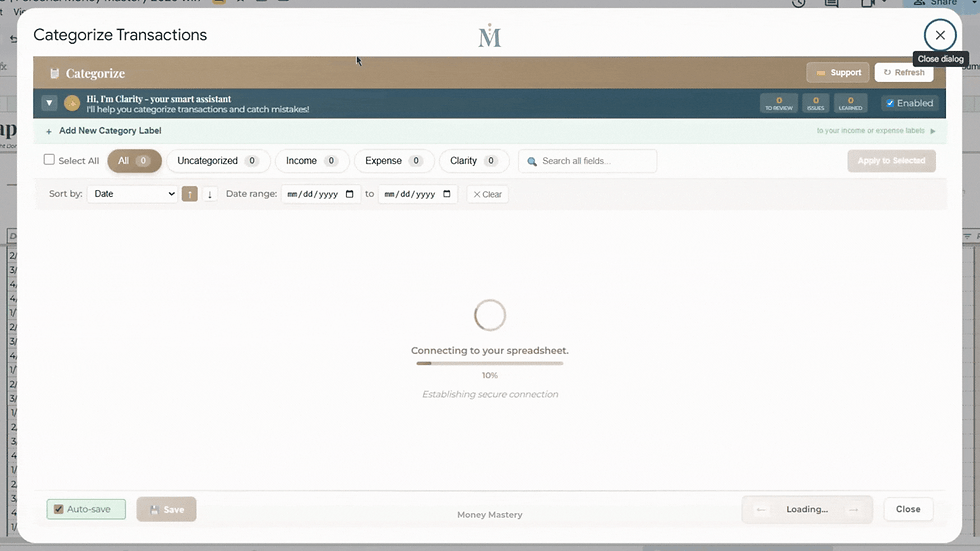
Here is the idea. Every time you review your expenses (whether in a Google Sheet from our budgeting guide or in Money Mastery's dashboard), add a simple tag or note to any purchase that was emotionally driven. You do not need a complicated system. Just a one-word tag: "stress," "bored," "celebration," "impulse," or "planned."
After 30 days of tagging, you will have a map of your emotional spending patterns that no budgeting app can give you on its own. You will see things like: "I spend the most on impulse purchases on Fridays after work." Or: "Every time I argue with a client, I buy something online within two hours." Or: "My stress spending spikes every month around the 15th when bills come in."
In Money Mastery, you can flag any transaction and add a note directly to it. During your monthly financial review, pull up all flagged transactions and look at them together. What do they have in common? How much did they cost in total?
Was any of it worth it?
This is what I mean when I say Money Mastery lets you have a conversation with your money. You are not just seeing numbers. You are seeing behavior. And when you see behavior clearly, you can change it.
Strategy 5: Unsubscribe, Unfollow, and Remove the Triggers From Your Environment
If emotional spending is the fire, your environment is the kindling. And most of us are surrounded by it without even realizing it.
Think about it. Promotional emails land in your inbox 10 to 15 times a day. Social media feeds show you targeted ads based on things you have already looked at. Shopping apps send push notifications about flash sales. TikTok and Instagram put products in front of you inside content that feels organic but is designed to sell.
Capital One Shopping's research found that 48% of social media users have impulsively bought something they first saw on a social media feed. The average annual spending on social media impulse buys is $754. And 55% of TikTok users make impulse purchases directly on the platform.
The LendingTree study backs this up with a specific recommendation from Matt Schulz: "Unsubscribe from promotional emails, mute shopping apps, and unfollow brands that trigger impulse buys. Out of sight, out of cart."
Here is what I want you to do this week. Spend 15 minutes going through your email and unsubscribing from every promotional list that is not actively saving you money on something you already planned to buy. Go to your phone settings and turn off push notifications for every shopping app. On social media, unfollow or mute any brand account that consistently makes you want to buy things you do not need.
This is not about deprivation. This is about designing an environment that supports your financial goals instead of undermining them. We talked about this principle in our post on building smart money habits for entrepreneurs: your environment shapes your behavior more than your willpower ever will.
Strategy 6: Build a "Fun Money" Category Into Your Budget So You Never Feel Deprived
One of the biggest reasons emotional spending spirals out of control is that people try to stop spending entirely, and then they snap. Willpower is a finite resource. If your budget feels like a punishment, you will rebel against it eventually.
That is why I always recommend building a "fun money" or "guilt-free spending" line into your budget. This is a set amount each month, decided in advance, that you can spend on absolutely anything without justification. A coffee. A book. A random kitchen gadget. Whatever. No guilt.
The power of this approach is that it removes the "forbidden fruit" effect. When you know you have $100 (or $50, or $200, whatever your budget allows) set aside for spontaneous purchases, you do not feel like every purchase is a battle between desire and discipline. You just check: "Is this within my fun money for the month?" If yes, enjoy it. If no, it goes on the 48-hour list.
If you built your budget using our conscious spending plan or our needs vs. wants framework, you already have a structure for this. Your "wants" category is where fun money lives. The trick is giving it a specific number so it does not expand to fill every available dollar.
In Money Mastery, you can set a custom category for guilt-free spending and track it against a monthly cap. When you see the remaining balance shrinking, it naturally encourages you to be more selective about what makes the cut, without any white-knuckle willpower required.
Strategy 7: Replace the Reward Loop With a Free or Low-Cost Alternative

Remember the dopamine loop I mentioned earlier? Your brain wants a reward. The problem is not the wanting. The problem is that shopping has become the default reward.
The fix is not to eliminate the reward. It is to replace the delivery mechanism.
When you feel the urge to spend emotionally, try one of these instead. Take a 15-minute walk outside. Call a friend you have not talked to in a while. Make yourself a nice meal with ingredients you already have. Write down three things you are proud of this week. Work on a creative project. Exercise. Play music. Clean one small area of your space and enjoy how it looks afterward.
These are not random suggestions. Each one activates the same reward pathways in your brain that shopping does, but without the financial hangover. The key is having a list ready before the urge hits, because in the moment, the easiest thing to do is the thing you have always done.
Olivia Crosio from the Apartment Therapy experiment discovered something similar. Instead of buying a $250 Apple Watch to track her fitness, she mentioned it to her dad, who had an old Fitbit he could pass along. "I saved $250, gained a tool that I actually use daily, and shared a moment that felt much richer than a two-day shipping confirmation ever could."
That is the real secret. Emotional spending is often a substitute for connection, accomplishment, or relief. When you find other ways to meet those needs, the spending urge does not just decrease. It often disappears.
How to Track Your Progress and See the Savings Add Up
Awareness without tracking is just a good intention. I want you to actually see the money you are saving by interrupting emotional spending, because that visual proof is what turns a one-week experiment into a permanent habit.
Here is my recommendation. At the end of each month, during your monthly financial review, add up two numbers.
First, the total of your tagged emotional or impulse purchases that you went ahead and made. This is your current emotional spending number.
Second, the total of items on your 48-hour list that you decided not to buy. This is your saved-from-impulse number.
Compare those two numbers. If your saved-from-impulse number is growing and your emotional spending number is shrinking, you are winning. And you can see it in black and white on your financial dashboard.
In Money Mastery, you can pull this up in the reports by filtering for flagged transactions. The month-over-month comparison shows you whether the pattern is improving, staying the same, or getting worse. No judgment. Just data. And data is how patterns change.
Remember, the Omni Calculator survey found that 20% of Americans now take more time before making spending decisions after experiencing financial regret. You are joining a growing group of people who are choosing awareness over autopilot. That is something to feel genuinely good about.
Your Action Step This Week
Start the 48-hour list today. Open your phone's notes app and create a note called "48-Hour Wait." The next time you feel the urge to buy something unplanned, write down the item, the price, the date, and one sentence about how you are feeling in that moment. Check back in 48 hours. See what happens.
Then, during your next expense review, tag at least five recent transactions as "planned" or "impulse." Just five. That small act of categorization will start to reveal patterns you have never noticed before.
If you want a tool that makes this effortless, our Net Worth Tracker includes a spending awareness worksheet, a 15-minute financial clarity guide, and a monthly review template that pairs perfectly with everything we covered today.
Your emotions are not the enemy. They are information. A dashboard and a little awareness turn that information into power.
Frequently Asked Questions About Emotional Spending and Impulse Purchases
Is emotional spending the same as impulse buying?
They overlap, but they are not identical. Impulse buying is any unplanned purchase, whether driven by emotion or not (like grabbing a candy bar at checkout). Emotional spending is specifically driven by a feeling: stress, excitement, sadness, boredom, or celebration. Most emotional purchases are impulse buys, but not all impulse buys are emotional. The strategies in this post address both, because the circuit-breakers work regardless of the trigger.
How much money can I actually save by stopping emotional spending?
The numbers are significant. The average American spends $282 per month on impulse purchases ($3,381 per year). Even cutting that in half saves you over $1,600 annually. One person saved $550 in a single month using just the 48-hour rule. For a small business owner, the savings can be even larger because emotional spending often extends to unnecessary software upgrades, equipment, and business "investments" that were really just impulse purchases in disguise.
What if I already know my triggers but still cannot stop?
Knowing your triggers is step one, not the finish line. The strategies in this post are designed to work together as a system: the 48-hour rule creates space, the purchase pause creates awareness, transaction tagging creates accountability, environment changes remove temptation, fun money prevents deprivation, and reward replacement gives your brain something else to reach for. If you are still struggling after implementing all of these consistently, it may be worth speaking with a financial therapist or counselor who specializes in spending behavior. There is no shame in getting support.
Does the 48-hour rule work for online shopping?
It works especially well for online shopping. Most online purchases happen in seconds because the feedback loop is so fast. Adding a 48-hour pause disrupts that loop completely. One practical tip: remove saved credit cards from your browser and shopping apps. If you have to manually enter your card number, that extra friction serves as a built-in pause even before the 48 hours begins.
How do I handle emotional spending as a business owner when expenses feel justified?
This is one of the trickiest areas because business expenses can feel "productive" even when they are emotionally driven. The three-question pause from Strategy 3 is your best tool here: Am I buying this because the business needs it right now, or because I feel something right now? If I wait 48 hours, will this still feel necessary? Does this align with my business financial goals? If you find yourself upgrading tools, subscribing to new software, or buying equipment right after a stressful week or a big win, that pattern is worth examining. Our post on spending leaks that quietly drain your business can help you spot these patterns.


Comments