


Monthly Financial Review Checklist: How to Review Your Finances in 15 Minutes or Less
Updated: Sep 17
A monthly financial review checklist is the single most valuable habit a business owner can build. Not because it's complicated. Because it's consistent. Most people don't avoid their monthly money check-in because they're lazy or don't care. They avoid it because they don't have a clear, repeatable process. They sit down, open their bank account, feel a wave of confusion or dread, and close the laptop. That's not a character problem. That's a process problem.
This post gives you the complete monthly financial review checklist you can use every single month, whether you run one business or three, whether your income is steady or unpredictable. The whole thing takes about 15 minutes. And those 15 minutes will give you more financial clarity than most people get in an entire quarter.

Why Every Business Owner Needs a Monthly Financial Review Checklist
The reason a monthly financial review checklist matters is simple. Without one, you're relying on memory and instinct to manage your money. And memory is unreliable, especially when you're running a business, managing clients, and handling everything else in your life.
A monthly review gives you a structured moment to pause and see the full picture. It answers questions you might not even think to ask during the daily grind. Questions like: did my income go up or down compared to last month? Which expense categories grew? Am I on track with my savings goals? Are there charges I don't recognize?
The monthly review isn't about finding problems. It's about seeing patterns. A single month in isolation doesn't tell you much. But when you compare this month to last month and the month before that, you start seeing trends that would be completely invisible otherwise.
Business owners who do a monthly money check-in consistently report feeling more confident about their financial decisions, less stressed about money overall, and better prepared for tax season. Not because the review itself is magical, but because it replaces guessing with knowing.
The 15-Minute Monthly Financial Review Checklist
Here's the complete process, broken into three five-minute blocks. You can do this on the last day of the month, the first day of the new month, or any day within the first week. Pick a day and make it yours.
Minutes 1 Through 5: Review Your Income
Start with what came in. Look at your total income for the month, broken down by source if you have multiple income streams.
Ask yourself these questions. Is this higher or lower than last month? Is it higher or lower than the same month last year, if you have that data? Did any expected income not arrive? Are there any deposits you don't recognize or need to follow up on?
If you run a business, separate your business revenue from any personal income like a side gig, a partner's paycheck, or investment returns. You want to see each stream clearly, not as one combined number.
Write down your total income number. That's your starting point.

Minutes 5 Through 10: Review Your Expenses
Now look at what went out. This is where most people either spend too long or skip entirely. The key is to look at categories, not individual transactions.
Your goal in these five minutes is to answer four questions. What were your top five spending categories this month? Did any category increase significantly compared to last month? Are there any recurring charges that are new or that you forgot about? Is there anything in your transactions that you don't recognize?
You don't need to examine every single transaction during your monthly review. That's what your weekly check-in is for, if you've set one up. The monthly view is about the big picture. Categories, totals, and trends.
If you've been following this blog series, you already know the value of separating business and personal finances into distinct categories. During your monthly review, look at both sides separately. Check your business expenses first, then your personal expenses. This prevents the two from blurring together in your analysis.
Write down your total expenses and flag any category that surprised you.
Minutes 10 Through 15: Check Your Financial Health Indicators
The last five minutes are where the real value lives. This is where you zoom out and look at the numbers that tell you whether you're moving forward or standing still.
Check these indicators. What's your net income this month (total income minus total expenses)? How does that compare to last month? What's your current savings balance, and did it go up or down? What's your current debt balance, and did it go up or down? Are you on track for any financial goals you've set?
These numbers don't need to be perfect. Estimates and round numbers are fine for the monthly check-in. What matters is that you're looking at them regularly so you can spot trends early instead of discovering them during a crisis.
Write down your net income, your savings balance, and your debt balance. Those three numbers, tracked monthly, tell you more about your financial health than any single report ever could.
Download the free Money Mastery Net Worth Tracker at https://moneymastery-system.com/free. It puts your personal and business accounts side by side across sixty account types and twelve tabs, and it stays yours.

What to Compare During Your Monthly Money Check-In
A monthly financial review checklist becomes exponentially more useful when you're comparing, not just observing. Looking at one month of numbers in isolation is like reading one page of a book. You need context.
Here's what to compare each month.
Compare this month's income to last month's income. This tells you whether your revenue is growing, shrinking, or staying flat. For business owners with seasonal fluctuations, also compare to the same month last year if you have the data.
Compare this month's total expenses to last month's total expenses. A jump in expenses isn't automatically a problem. But an unexplained jump is worth investigating. Maybe you had a one-time purchase. Maybe a recurring charge increased without notice. Maybe a category is creeping up gradually.
Compare your net income trend over the last three months. This is the most revealing comparison. One low month might be a fluke. Three consecutive months of declining net income is a trend that deserves your attention.
Compare your savings progress to your goals. If you set a goal of saving $500 a month and you saved $200, that's useful information. Not for beating yourself up, but for adjusting either the goal or the strategy.
If you've been categorizing your spending using a needs vs wants framework, your monthly review is the perfect time to check the ratio. How much went to needs? How much went to intentional desires? How much was unconscious spending? That breakdown, tracked over time, shows you whether your money is aligning with your priorities.
The Five Questions to Ask During Every Month-End Financial Checklist
Numbers are only useful if you interpret them. After looking at your income, expenses, and financial health indicators, run through these five questions.
The first question: did anything surprise me? Surprises aren't always bad, but they always deserve attention. A surprise could be a charge you forgot about, a category that spiked, or income that came in higher than expected. The point is to notice.
The second question: am I spending in alignment with my priorities? This connects directly to the values-based spending we discussed in the needs vs wants post. Your monthly review is where you check whether your actual spending matches your stated priorities.
The third question: is there anything I should change for next month? Maybe you noticed a subscription you want to cancel. Maybe you want to increase your tax savings set-aside. Maybe you realized you're undercharging a client. The monthly review is where observations turn into action items.
The fourth question: do I need to follow up on anything? Unpaid invoices, pending reimbursements, charges to dispute, insurance renewals coming up. Write them down so they don't fall through the cracks.
The fifth question: how do I feel about my money right now? This one might sound soft, but it matters. If you feel anxious, that's information. If you feel confident, that's information too. Your emotional relationship with money shifts as your clarity increases, and tracking that shift reminds you why the review matters.

How a Monthly Finance Routine Becomes Automatic
The first few monthly reviews will feel unfamiliar. You might need to look up account balances in different places, manually calculate your net income, and dig through statements to find category totals. That's normal. It gets faster every single month.
By the third month, you'll know exactly where to look for each number. By the sixth month, the whole process might take you 10 minutes instead of 15. By the end of a year, the monthly review will feel as natural as checking your email.
The key to making it automatic is consistency, not perfection. If you miss a month, don't try to catch up by doing two months at once. Just do the current month and move forward. The habit matters more than the streak.
Some people set a recurring calendar reminder on the first of each month. Others tie it to something they already do, like their first Monday coffee or the day they pay their rent. Whatever anchor works for you, attach the review to it.
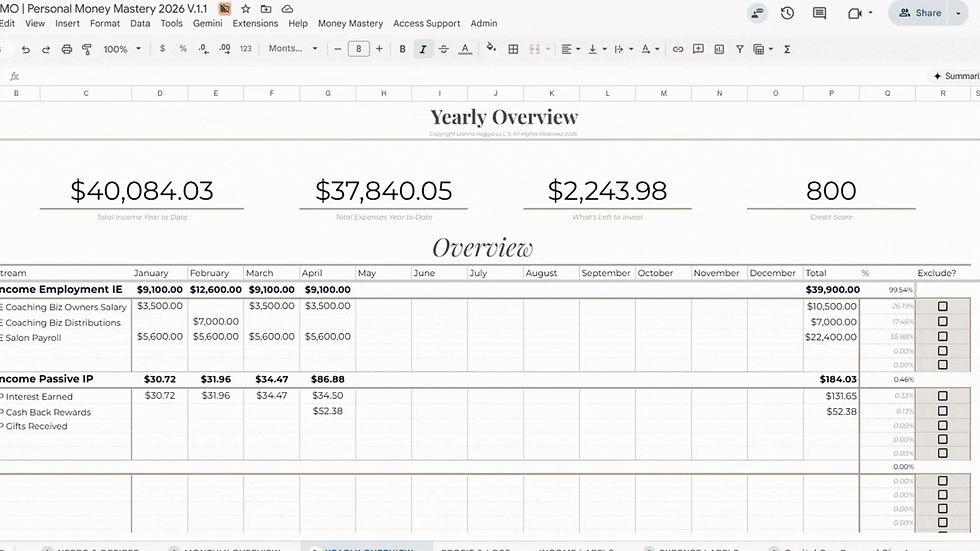
If you want the process to be even faster, a system that organizes your data for you makes a significant difference. Money Mastery's dashboard, for example, shows your income vs. expenses, category breakdowns, savings progress, and net worth all in one view. Instead of pulling numbers from four different places, you open one dashboard and everything is already there. Clarity AI can even generate custom reports if you want to dig deeper into a specific category or time period.
How Your Monthly Financial Review Checklist Connects to Everything Else
Your monthly review doesn't exist in isolation. It's the habit that ties all your other financial practices together.
The money tracking system you set up gives you the data. The needs vs wants framework gives you the categories. The separation between business and personal finances gives you clarity on both sides of your money. And the monthly review is where you sit down, look at all of it, and ask "what does this tell me?"
Without the review, the data just sits there. With the review, it becomes insight. And insight is what drives better decisions.
This is also the moment where you'll start to see the value of having a complete financial system rather than a collection of separate tools. When your income, expenses, savings, debt, and goals all live in one place, the monthly review becomes a five-minute scan instead of a 30-minute scavenger hunt across multiple apps and accounts.
Start Your First Monthly Review This Week
You don't need to wait until the end of the month to start. Pull up your accounts right now and run through the checklist with whatever data you have from this month so far. Even a partial review builds the muscle.
Here's your action step for today. Set a recurring 15-minute calendar reminder for the first day of next month. Label it "Monthly Money Check-In." When it arrives, open this post, follow the three five-minute blocks, and answer the five questions. That's your entire month-end financial checklist, and it takes less time than scrolling through social media.
Tomorrow, we'll cover how to read a profit and loss statement, even if you've always avoided them. Understanding your P&L is one of the most powerful things you can take away from your monthly review.
Get your free Net Worth Tracker and see where your money actually goes, in 15 minutes. https://moneymastery-system.com/free
Frequently Asked Questions
What should be on a monthly financial review checklist?
A complete monthly financial review checklist should cover three areas: income review (total income by source, comparison to prior months), expense review (top spending categories, any surprises or new charges), and financial health indicators (net income, savings balance, debt balance, and goal progress). The whole process should take 15 minutes or less when you have a consistent system in place.
How long does a monthly money check-in take?
With a clear process and organized records, a monthly money check-in takes about 15 minutes. If your financial data lives in one system like Money Mastery, it can be even faster because your income, expenses, savings, and net worth are already calculated and displayed in one dashboard view. The first few reviews may take slightly longer as you establish the routine.
What is the difference between a weekly and monthly financial review?
A weekly review focuses on recent transactions: categorizing new charges, catching anything unusual, and keeping your records current. A monthly review zooms out to look at totals, trends, and comparisons between months. The weekly review keeps your data clean. The monthly review turns that clean data into insights and action items. Both serve different purposes and work best when used together.
When is the best time to do a monthly financial review?
Most business owners find that the first three days of the new month work best because all of the prior month's transactions have cleared. Some prefer the last day of the month. The specific day matters less than the consistency. Choose a day, set a recurring reminder, and protect those 15 minutes as a non-negotiable part of your monthly finance routine.
Do I need special software for a monthly financial review?
No. You can do a monthly review with nothing more than your bank statements and a notebook. However, having a system that organizes your data into categories, tracks trends over time, and shows your full picture in one view makes the review significantly faster and more insightful. Money Mastery provides all of this in a single Google Sheets-based dashboard with AI-powered reports you can run anytime.
Related Posts:
How to Track Where Your Money Goes (Without Spending Hours on Spreadsheets)
How to Separate Business and Personal Finances (Even If You've Been Mixing Them for Years)
Needs vs Wants Budgeting: How to Categorize Your Spending So It Actually Makes Sense
How to Read a Profit and Loss Statement (Even If You Hate Numbers)


Comments